
The Reach
Latest in the studio
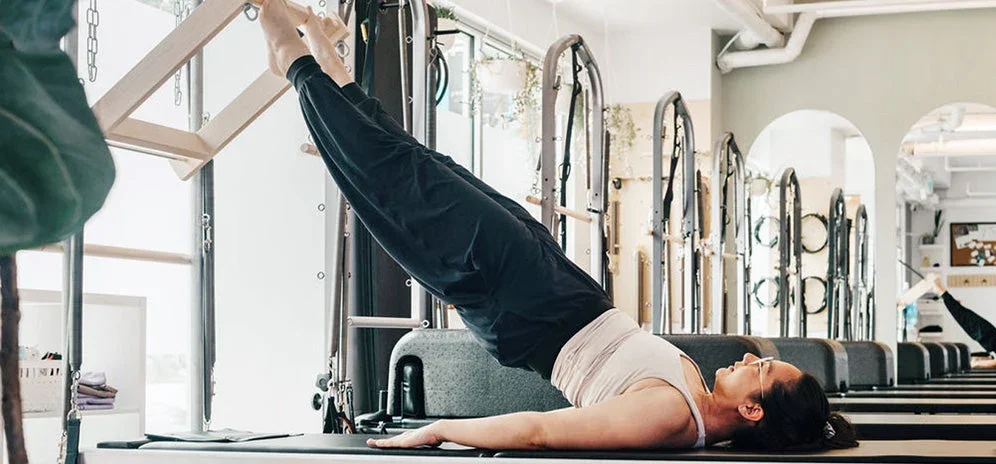
Watch Noam in action as he explores the high bridge progression in the Contrology Lab hosted by Balanced Body
Classical Pilates: Not Rigid, Just Simple
Originally published in The Contrology Journal.
I came to Classical Pilates with my guard up.
I had been a Registered Massage Therapist for over 15 years and a certified Pilates teacher trained in a contemporary program. I thought I understood the method. I knew the exercises. I knew the choreography. And yet something was missing, and I couldn't name it. I found myself lost, adrift in the noise of the contemporary Pilates world, the endless Instagram reels and YouTube tutorials, each one pulling the method in a different direction. I kept asking myself: how is this any different from going to the gym, except that we're on apparatus’?
I had heard of Classical Pilates, of course. But from the outside, it seemed stuffy. Rigid. Unwelcoming. A world with its back turned to anyone who hadn't been trained in a particular lineage. So I stayed away until I brought my frustration to my mentor, Lauren Brandt. I feel lost, I told her. I don't understand what we're accomplishing. She listened, and then said something simple that changed everything: Get curious about the classical world.
So I did. I was fortunate enough to enroll in Beyond Pilates with Noam Gagnon at The Pilates Collective, a classical teacher training program that didn't just teach me the method, it gave me back my love for it.
Two Worlds, One Method
What I discovered surprised me. Classical and contemporary Pilates are not enemies. They are not even opposites. They are two expressions of the same method, one that has stayed close to its origins, and one that has evolved, sometimes beautifully, sometimes at the cost of its own foundation.
The contemporary world offers creativity, accessibility, and variety. But that variety can come at a price. When exercises are rearranged from session to session, modified beyond recognition, or taught without regard for sequence, something essential is lost, the intelligence of the order itself. Joseph Pilates designed his method deliberately. Each exercise prepares the body for the next. The foundation builds the intermediate. The intermediate builds the advanced. That is not rigidity. That is the method working exactly as it was designed to work.
The classical apparatus reflects this same philosophy. Where contemporary equipment offers endless variation in spring tension, which sounds like freedom but often creates confusion, the classical apparatus is elegantly simple. Every spring carries the same tension. You learn the spring, you learn the body, and you learn how they work together. Simplicity, I have come to understand, is not a limitation. It is a gift.
What Advanced Really Means
Here is what classical training taught me that changed everything about how I teach: advanced does not mean complicated. It does not mean harder, faster, or more impressive. Advanced means more of you showing up in the work.
I no longer feel the need to program advanced exercises into every session. The advanced work is already there, living inside the foundational and intermediate exercises, waiting to be found. When a student is truly in the Hundred, when they are breathing fully, connecting deeply, and moving with genuine intention - that is advanced work. The body that masters the foundation will arrive at the advanced repertoire naturally, because it has already done the work to get there.
This shift has quietly transformed the way I stand in front of a client. I am no longer teaching exercises. I am teaching a body to build itself.
The Student I Didn't Know I Still Was
Before I found classical Pilates, my perception of it was shaped by what I saw from the outside and what I saw kept me at arm's length. It seemed exclusive. Intimidating. A world that required a particular lineage, a particular language, a particular way of moving that I hadn't been taught. That perception was mine alone, built from a distance. And like most things we judge from a distance, it turned out to be wrong.
What I found when I finally stepped inside was something I hadn't expected: I was invited to begin again. And beginning again, I quickly learned, is one of the most powerful things a teacher can do. My ego had plenty to say about that. She showed up loud and resistant, reminding me of my credentials, my experience, my years of bodywork. And then, quietly, she settled down. Because what was happening was not a demotion. It was a gift. I was being given a beginner's mind and there is nothing more valuable for a teacher than to remember what it feels like to not yet know.
The so-called rigidity of classical Pilates, I now understand, is not rigidity at all. It is clarity. It is a method that trusts itself enough not to need constant reinvention. And stepping into that clarity, even as an experienced teacher, felt less like restriction and more like finally having solid ground beneath my feet.
Classical and Contemporary Together
I am not here to tell you that contemporary Pilates is wrong. I am here to tell you that classical Pilates is not what you think it is. It is not rigid. It is not exclusive. It is not a closed door. It is a method so thoughtfully designed that when you stop trying to complicate it, it opens up in ways you never expected.
The two worlds can live together. Contemporary Pilates brought many of us to the mat. Classical Pilates, for me, revealed what the mat was always meant to be. A place to come home to your body. A place to breathe fully, move intentionally, and find the advanced work hiding inside the simple things.
I have been fortunate to walk both worlds, guided first by Lauren Brandt, who gave me the courage to get curious, and then by Noam Gagnon, who showed me what curiosity could become. Two remarkable teachers. Two chapters of the same journey. I am deeply honoured to have had both of them in my corner.
You don't need more exercises. You need to go deeper into the ones you already have.

The Art Of Teaching Pilates
It all begins with an idea.

The Art of Teaching Pilates
by Noam Gagnon
(First published on Profitable Pilates blog)
You know you are a real Pilates nerd when you own more Pilates t-shirts than regular ones. My favourite t-shirt was recently given to me by my amazing Pilates family at Vintage Pilates in Los Angeles. On it, it says “We don’t change the work, the work changes us”.
I was first introduced to that concept back in 2000 during my teacher training at The Pilates Centre in Boulder Colorado. It’s through their instruction that I realized teaching is an art. My perception is perhaps a little askew due to being a dance artist most of my adult life. I first encountered Pilates in 1987 during my first professional dance job with a company in which we took Pilates three times a week. I immediately fell in love with Pilates so I practiced every day religiously, so much so that over time I gradually stopped taking dance classes and trained only with Pilates.
A few years later, I asked my teacher about getting certified but her advice to me at the time was to wait and focus on my dance career and its intense touring demands. I waited, keeping my practice while I danced and toured the world. Despite the ferocious physicality of our dance repertoire and the intense touring demands for close to two decades, I am still dancing today. Joseph Pilates’ work kept me dancing and I can say proudly that I am aging gracefully in both my body and my mind.

After 30 years of personal practice, teaching others, performing, choreographing, training teachers and being a Franklin Method movement educator I find myself continually asking myself the same question: What is teaching? How do I further deepen my teaching while continuing to enhance the experience for my clients?
Teaching and being taught for decades all ultimately led me to meet Jay Grimes. For those of you who are not aware of who Jay Grimes is, Jay began his studies with Joseph Pilates in the mid-1960’s, and after Joe’s death continued studying with Joe’s wife Clara for another 10 years until her death. Jay began teaching in their original 8th Avenue studio in New York City and has since taught all over the world. Jay now teaches and directs The Work, an intense graduate program for certified teachers at Vintage Pilates in Los Angeles. The first day of the program Jay told us something to the effect of sorry guys, bad news, I can't teach you Pilates: Pilates must be felt, with time assisting the process. I found Jay to be a man of few words, observing and then asking a question or commenting with pinpoint accuracy, with maximum effect.
Gaining Pilates knowledge is easy, wisdom is harder to acquire. My practice and teaching have undergone many different incarnations over the years but what has stayed constant is my desire to always go deeper into understanding and embodying the principles of the incredible system that Joe created. It's been about accumulation, over time. My favourite Pilates t-shirt is dead on correct: doing the work changes me.

As teachers and practitioners of Pilates, be it Classical or contemporary, we are all learning and growing. I personally chose Classical Pilates because it was ultimately a better fit for my character and personality. Creating a practicing and teaching community and embracing others into our pool of information to share and grow together is crucial to our industry. We can learn and grow faster, getting deeper and deeper into the work, together.
Many years of dancing, choreographing and teaching has simultaneously sharpened my instructor tools and given me my super power: an eagle eye. Seeing what is going on in someone’s body is easy. What has been humbling and challenging is learning to wait, to be able to choose the right timing, the right word, the ideal image, the right touch, that can create indelible change. For me, after decades of accumulating information and skills, the art of teaching Pilates comes down to simply this: Observing clients while teaching them is easy. It’s what we do with what we observe that is the true art of teaching Pilates: being able to choose the right words to create the right experience at the right moment to effect positive change in the client’s body and practice.